










“Do what you love and the money will follow.”
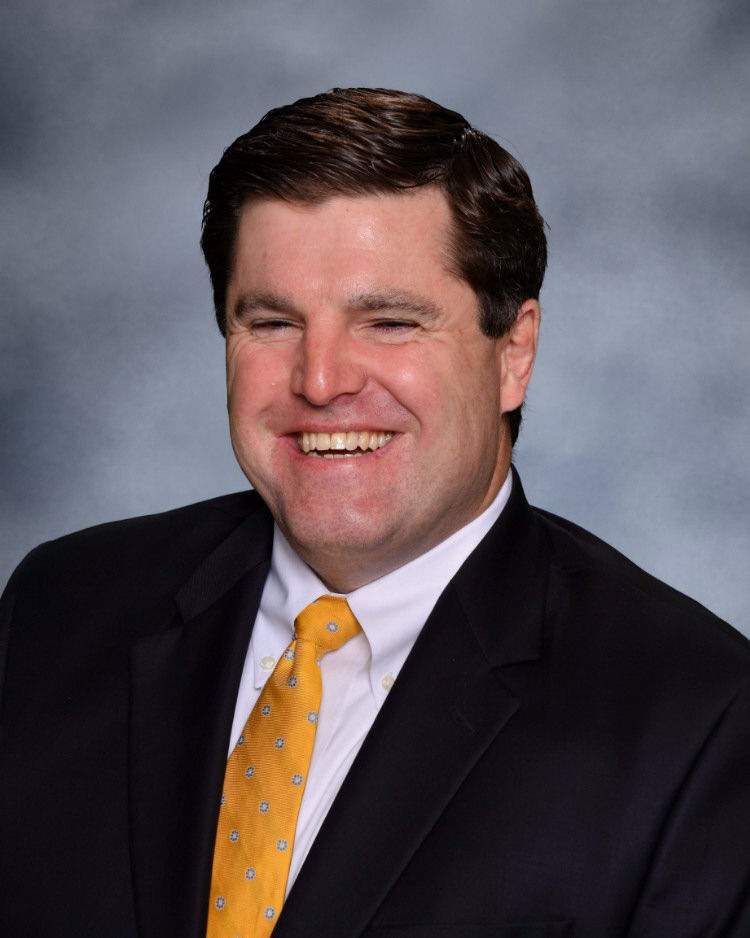
It’s not the kind of motto one would expect from someone managing hundreds of students, dozens of teachers and endless paperwork, but for Principal Dave Wedlock, it embodies the spirit of his work. Each day at Francis Howell High School brings something new to the table, from constant decisions to fresh conversations and small victories, all adding up to success that reflects his leadership.
For most students, the school day begins when the bell rings. For Wedlock, it starts long before that.
“The first thing I do [in the morning] is [go to] my office and put my lunch away,” Wedlock said.
From there, the day turns immediately to his responsibilities. He turns on two radios that each serve a specific purpose.
“One is the building radio, which [allows staff to] be anywhere on campus and speak to other people [via] radio,” Wedlock said. “There’s also a police radio that only has one purpose, and that is in a catastrophic event.”
Once safety is ensured, Wedlock turns his attention to his email.
“After that, I turn on my computer and see what I [have] to do [for the day],” Wedlock said.
The answer is almost never predictable. Unlike teachers who follow class schedules that are pretty set in stone, Wedlock’s role shifts with seasons, crises, events and timelines.
In the fall, most of his time is spent in classrooms evaluating teachers. By winter, his priorities are set on budgeting, when the school begins ordering supplies for the following year such as “tables, chairs, desks, lamps, and cameras,” Wedlock said.
Spring turns into staffing season, followed by senior events and graduation preparations.
Even on a “calm” day, Wedlock says he is balancing meetings, parent communication, student concerns and district updates, all while trying to be present, in the hallways, visible to students and teachers.
With great power comes great responsibility, and with great responsibility comes immense pressure, pressure that doesn’t disappear from year to year.
“The most challenging part of being a principal is that […] wherever you are today, tomorrow you’re better,” Wedlock said.
The expectations aren’t just from personal growth, but rather school-wide progress (academically, socially and culturally). That requires teamwork from every classroom, every department and every adult in the building.
“We can have the smartest student in America. We can have the best teacher in America. But one student, one teacher [doesn’t] make a school,” Wedlock said.
Despite the weight of expectation, the results make the work worth it. Wedlock referenced past achievements: statewide improvement, recognition as a teacher and awards like the Blue Ribbon and Missouri Gold Star as a principal, all of which Wedlock described as “really gratifying.”
“It means a whole group of people improved and met a goal that maybe people thought couldn’t even be achieved,” Wedlock said.
Like every principal in the Francis Howell School District, Wedlock follows a multi-page School Improvement Plan (20+ pages to be exact). But the heart of his goals can be simplified into one metaphor: “Lighting the torch.” At the beginning of the year, he asked his staff to imagine the “energy” felt on the first day of school, when the hallways are loud, the outfits are new and the year feels full of possibilities. His goal is to carry that feeling forward instead of letting it burn out by October.
In Wedlock’s words, the role of educators is to “build ladders” so that students can reach the opportunities they want in life. That means a strong curriculum, strong teaching and a strong school climate.
The job title may sound serious, but Wedlock is far from a one-dimensional administrator.
He does not drink coffee or tea, as many of the staff do, instead opting for cashew milk.
He once competed in the Little 500 bike race at Indiana University Bloomington, a 50 mile team relay event that was once broadcast on ESPN.
“I was not good at it,” Wedlock said, “but I can say I’ve been on ESPN.”
Like many educators, Wedlock’s career wasn’t this elaborate, mapped out plan he had dreamed of when he was five. Instead, a college professor once told him, “Do what you love, and the money will follow.”
That became his turning point.
“Eighteen-year old Dave Wedlock did not know he would live in Missouri, [or had] ever heard of Francis Howell, [or] that I would be a teacher or principal here,” Wedlock said. “But that passion […] has led me to this place.”
Whether he is answering a radio call, walking the hallways, approving budgets or shaking hands on graduation day, Wedlock sees every part of his job as connected.
Graduation, he admits, is one of his favorite events of the year, not because it signals the end, but because it’s the moment students realize what they’ve earned.
“They get their name read, and they have this moment where they don’t know where they are, because they’re like, ‘Oh my god, I just actually graduated,’” Wedlock said.
By the time the diploma touches students’ hands, Wedlock has already seen the budget that bought their desks, the teachers who taught their classes, the decisions that shaped their schedules and the steps that helped them climb their ladder.
Students see the principal at big moments, but the real work happens in the hours no one watches, the planning, preparing and effort to make sure the school keeps moving. From the first radio check of the morning to the final diploma of the year, Wedlock’s job is built on what happens beyond the desk.